What Is White Label Coffee?
White label coffee gives businesses a way to launch branded coffee products without building roasting operations from scratch. It can support cafés, retailers, corporate gifting programs, hospitality groups, and new coffee brands that want quality coffee with a more efficient path to market.



What Is White Label Coffee?
As more businesses look for ways to expand their product lines, strengthen their brand identity, or create new revenue opportunities, white label coffee has become a more attractive option.
For some, it is a way to launch a coffee brand without building a roasting operation from the ground up. For others, it is a way to offer custom-branded coffee for retail shelves, hospitality programs, office gifting, client experiences, or online sales. Either way, white label coffee gives businesses a path to market that is faster and more practical than trying to source, roast, package, and manage everything internally.
But what exactly is white label coffee, and how does it work?
White label coffee is coffee that is roasted and produced by one company, then packaged and sold under another company’s brand.
Instead of operating its own roastery, a business works with a coffee roasting partner that handles production while the business focuses on branding, positioning, customer experience, and sales. Depending on the program, that can include help with coffee selection, bag format, labeling, packaging, and production logistics.
In simple terms, white label coffee allows a business to offer its own branded coffee without having to build the full roasting infrastructure behind it.
How White Label Coffee Works
The exact process varies by roasting partner, but white label coffee usually follows a structure like this:
- A business chooses to launch or expand a branded coffee offering.
- The business partners with a roaster that can produce the coffee.
- Coffee products, roast profiles, formats, and packaging needs are discussed.
- The roasting partner produces and packages the coffee.
- The finished product is sold under the client’s brand rather than the roaster’s public-facing brand.
Some white label coffee programs are simple and standardized. Others offer more flexibility with blend selection, packaging design, and custom presentation.
The quality of the program often depends on the quality of the roaster behind it. A strong white label partner is not just filling bags. They are helping a business bring a coffee product to market in a way that reflects the brand well.
Why Businesses Use White Label Coffee
White label coffee appeals to businesses for several practical reasons.
It Creates a Faster Path to Market
Building a coffee brand from scratch can be complex. Sourcing, roasting, packaging, compliance, logistics, and quality control all take time and infrastructure. White label coffee allows businesses to move more quickly by working with a roasting partner that already has those systems in place. That makes it easier to test an idea, expand into coffee, or launch a branded product line without delaying the project behind operational setup.
It Reduces the Need for Internal Production Infrastructure
Roasting coffee in-house requires specialized equipment, trained staff, production processes, storage, and ongoing quality management. Many businesses do not need or want to take that on. White label coffee provides a way to offer coffee without having to own the full production side of the operation. That can be especially useful for businesses that want to stay focused on brand building, retail growth, hospitality experiences, gifting, or customer relationships rather than manufacturing.
It Supports Brand Expansion
Coffee can be a strong branded product. Businesses use white label coffee for retail lines, café extensions, subscription offers, event programs, private client gifts, company stores, hospitality amenities, and promotional campaigns. In many cases, the coffee itself becomes part of a wider brand experience. This is one reason white label coffee is relevant beyond traditional coffee companies. A business does not have to be a dedicated roaster to make branded coffee part of its offering.
It Makes Custom Packaging More Accessible
Packaging matters in coffee. For many businesses, one of the most appealing aspects of white label coffee is the ability to present the product under their own name and visual identity. A good white label program can help a business align its coffee packaging with the rest of its brand, which makes the offering feel more intentional and market-ready. That is particularly important when the goal is not just to sell coffee, but to create a product people remember and trust.
Who White Label Coffee Is For
White label coffee can make sense for a wide range of businesses and organizations. That includes:
- Retail brands
- Hospitality groups
- Cafés and restaurants
- Corporate gifting programs
- E-commerce brands
- Influencers or creators building product lines
- Organizations launching fundraiser products
- Businesses that want custom coffee for clients, employees, or events
The common thread is that these groups want branded coffee, but they do not necessarily want to build roasting operations from the ground up.
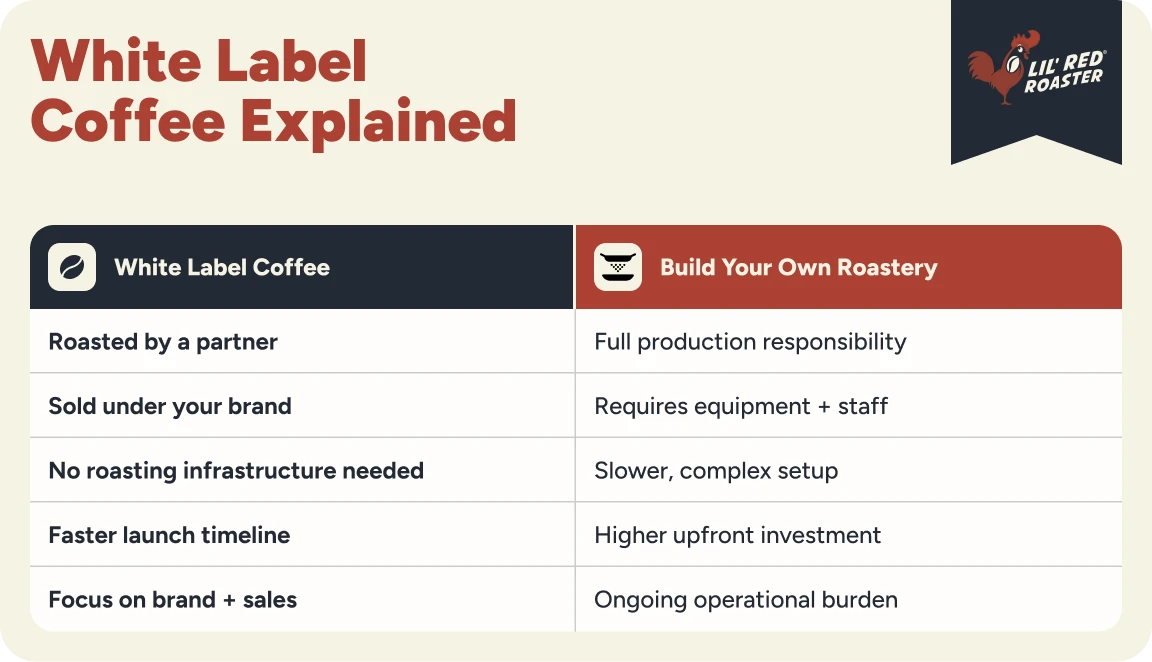
White Label Coffee vs. Building Your Own Roastery
For most businesses, the choice is not whether coffee is interesting. It is whether building internal production makes sense.
Owning a roastery gives a company more control, but it also creates far more complexity. It requires capital, staffing, operations, supply chain management, production expertise, equipment upkeep, and ongoing quality oversight.
White label coffee offers a different model.
Instead of investing in production infrastructure first, a business can work with an established roasting partner and focus on the market side of the opportunity. That usually means less operational burden, lower upfront complexity, and a more practical launch path. For many businesses, that is the difference between an idea staying theoretical and an actual coffee product reaching the market.
What to Look for in a White Label Coffee Partner
Not every white label coffee program is the same.
Businesses should look for a partner that can do more than just supply product. The right roaster should be able to support quality, consistency, communication, and a process that reflects well on the final brand.
Important things to evaluate include:
- Coffee quality
- Roasting approach
- Packaging options
- Production consistency
- Minimum order flexibility
- Communication and responsiveness
- Ability to support brand presentation
- Alignment between the coffee and the story the business wants to tell
A good white label coffee partner should help the finished product feel credible, polished, and worth putting your name on.
Why Roasting Quality Still Matters
Even when the product carries another brand’s name, the coffee still has to stand on its own.
That is why roasting quality matters so much in a white label program. If the coffee is inconsistent, forgettable, or poorly matched to the brand, the packaging alone will not carry the product very far.
Businesses should look for a roaster that cares about the coffee itself, not just the label on the outside. Small-batch attention, thoughtful roast development, and consistent quality control all make a difference when building a branded coffee offering that people will actually want to buy again.
White Label Coffee Is a Brand Opportunity, Not Just a Supply Decision
One of the biggest misconceptions about white label coffee is that it is only a sourcing arrangement. In reality, it is often a brand decision.
The right coffee product can reinforce positioning, create a stronger customer experience, open new sales opportunities, and give businesses a more tangible way to connect with their audience. That is especially true when the coffee reflects the brand well in both quality and presentation.
So while white label coffee simplifies production, it should still be approached thoughtfully. The product is not just another item. It becomes part of the business’s public identity.
Final Thoughts
White label coffee gives businesses a practical way to launch branded coffee without building roasting operations from scratch.
It can create a faster path to market, reduce production complexity, support custom packaging, and help businesses expand into coffee with less operational burden. At the same time, the success of the program still depends on the quality of the roasting partner, the strength of the product, and how well the coffee fits the brand behind it.
For businesses that want to add coffee to their offering in a credible and scalable way, white label coffee can be a strong option.