The Real Cost of Bad Coffee in the Workplace: Why It Quietly Impacts Productivity, Retention, and Culture
Bad workplace coffee is not neutral. Learn how weak beverage programs quietly drain productivity, harm company culture, and represent a massive hidden cost to your bottom line.


Bad Coffee Is Not Neutral
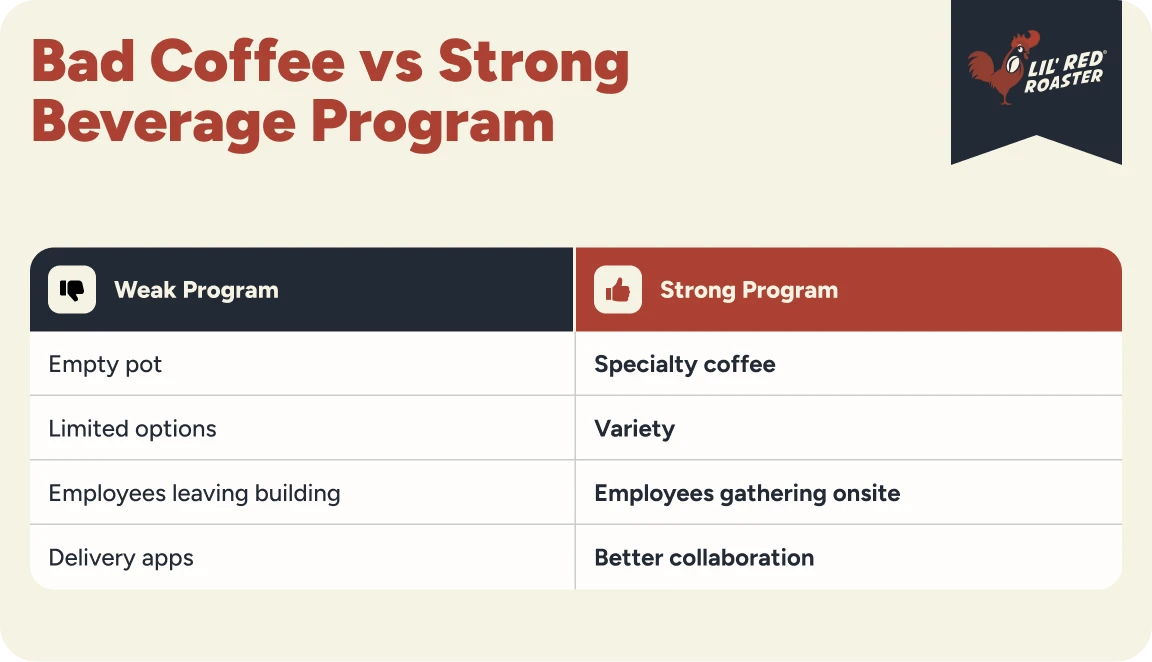
Most companies treat bad workplace coffee as a minor inconvenience. It is not. Bad coffee creates hidden cost because it fails to change behavior. Employees leave the office, order delivery, or disengage from the amenity entirely. The company still pays for the program, but the program does not produce value.
The right question for facility and HR leaders is not whether coffee exists in the break room. The right question is whether the coffee program changes behavior in a way that supports productivity, recruitment, retention, and culture. If the coffee is ignored, it is not an amenity; it is a liability.
The Core Problem: Cost Is Measured, Impact Is Not
Coffee programs are commonly evaluated by product cost, service cost, and machine cost. Procurement teams negotiate the lowest price per pound or per pod, assuming they have optimized the budget. They are rarely evaluated by usage, offsite trips avoided, employee satisfaction, or time recovered.
A cheap program that no one uses is not cost-effective. It is waste. A higher quality program that keeps employees on site may be the lower total cost option when overall productivity is considered. You cannot optimize a budget by funding a solution that employees actively avoid.
Is your current coffee program driving employees out the door?
Stop paying for an amenity your team ignores. Connect with Lil Red Roaster for a free workplace beverage consultation.
Productivity Loss From Offsite Coffee
When the onsite coffee is unpalatable, employees will naturally seek alternatives. A typical offsite coffee run—waiting for the elevator, walking to the café, waiting in line, waiting for the barista, and walking back—can take 15 to 30 minutes.
To understand the financial exposure, let us look at a conservative daily cost model for a mid-sized office:
The Offsite Coffee Cost Model:
- Employees Leaving Daily: 30
- Time Lost Per Trip: 20 minutes
- Total Daily Lost Time: 10 hours
- Total Weekly Lost Time: 50 hours
- Estimated Annual Labor Cost Exposure (at $30/hour): $78,000 per year
This productivity model is highly conservative. It completely excludes the cascading costs of delayed meetings, missed spontaneous collaboration, customer response delays, and the 15 to 20 minutes of focus recovery time it takes to get back into a deep-work state after an interruption.
Engagement Impact
Coffee is a signal. Employees notice whether the workplace invests in their daily experience. Low quality coffee, limited options, and poorly maintained equipment communicate that the environment is transactional and that their comfort is an afterthought.
Conversely, a strong beverage program communicates hospitality, care, and attention to the details that make the workday better. When an employer provides a café-quality experience just steps from an employee's desk, it builds subtle but consistent goodwill. It proves that leadership values the team's time and energy.
Retention and Culture
Culture is reinforced through repeated interactions. Coffee areas can become informal gathering spaces where employees connect, reset, and collaborate across departmental lines. When the better experience is offsite, those interactions leave the workplace and fragment the team.
This matters immensely for hybrid work environments. If companies want employees to value being onsite, the onsite experience has to justify the commute. Beverage quality alone will not solve culture, but it is one of the most visible daily touchpoints. A barren break room makes the office feel sterile; a vibrant, well-stocked coffee bar makes it feel like a destination.
Financial Waste
Bad coffee programs often create stale inventory, low usage, product waste, and low perceived value. The company sees invoices and assumes a benefit exists. The reality is that pots of burnt drip coffee are poured down the drain at the end of the day, and generic bulk pods sit expiring in cabinets.
Employees see a poor experience and choose something else, leaving the company paying for an unused perk while simultaneously absorbing the cost of lost productivity.
What High Performing Programs Do Differently
Strong programs focus on experience parity. They do not simply ask how to stock coffee. They ask how to compete with the external options employees already prefer.
That means offering the right mix of solutions. It requires stepping away from bulk commodity beans and moving toward comprehensive office coffee services. High-performing programs include single-cup variety, bean-to-cup quality, and traditional coffee where appropriate. Furthermore, it means recognizing that not everyone drinks coffee. A complete amenity strategy must include high-quality filtered water, commercial ice machines, cold beverages, and tea alternatives for non-coffee drinkers.
Decision Framework
If you are evaluating your current refreshment program, use this framework:
- Measure usage, not just cost.
- Identify how many employees still leave for beverages.
- Compare offsite time loss to program investment.
- Evaluate variety, freshness, and customization.
- Include water, ice, and cold beverage needs.
- Reassess quarterly based on behavior.
Consequences of Ignoring the Issue
If bad coffee persists, employees keep leaving, productivity leaks continue, and the company funds a benefit that does not perform. The cost is hidden because it is not coded as "coffee expense" on the P&L statement. It appears silently as lost time, lower engagement, weakened onsite experience, and ultimately, higher turnover.
Final Position
Bad coffee is not neutral. It is an operational inefficiency disguised as a minor amenity. A better beverage program does not just improve taste. It can reduce offsite movement, support culture, and improve the daily workplace experience.
If employees still leave the office for coffee, the program is not working. Measure the behavior, then redesign the experience.
Frequently Asked Questions
Q: Why is bad office coffee a business issue?
A: Because poor coffee programs often fail to change behavior, which means employees still leave the workplace and the company loses time and engagement.
Q: What should buyers measure besides cost?
A: Usage, offsite trips avoided, employee satisfaction, and total experience value are all important measures.
Q: How does coffee affect culture?
A: Coffee areas can support informal interaction and a stronger on-site experience when the offering is good enough to keep people engaged in the workplace.
Q: What does a stronger program usually include?
A: A stronger program often combines better coffee quality, variety, filtered water, ice, cold beverages, and better maintenance and service.
What This Unlocks Next
The next issue in the buying journey is rarely isolated. Once this question is answered, the next pressure point usually becomes visible in the next layer of the system.
Subscribe to get the next Lil Red Roaster insight on workplace coffee, espresso quality, private label and white label coffee, subscriptions, roast selection, and beverage