Private Label vs White Label Coffee: How to Choose the Right Model Without Wasting Capital
Understand the real differences between private label and white label coffee so you can launch faster, protect capital, and choose the right operating model.


The Decision That Looks Simple But Is Not
Businesses entering coffee often ask whether they should create their own product or use an existing roaster. That sounds like a branding decision. It is actually a capital allocation, operational risk, and speed to market decision.
Private label and white label are often used loosely, but the business implications are different. Choosing incorrectly can tie up cash, delay launch, increase operational burden, and slow validation. Choosing correctly can move a concept into market quickly with lower risk.
The Core Problem: Companies Overestimate Control and Underestimate Complexity
Entrepreneurs and brand teams naturally want control. They want unique blends, custom packaging, proprietary positioning, and differentiated product stories. Those goals are reasonable, but they require infrastructure.
Coffee is not only a brand asset. It is an agricultural, production, packaging, freshness, inventory, and distribution system. The more control a company wants, the more complexity it owns.
What Private Label Coffee Really Means
Private label typically means building a more customized coffee product under the client brand. Depending on the partner, this can include custom blend development, custom roast profiles, packaging decisions, minimum order requirements, inventory planning, and more detailed production coordination.
The advantage is control. The risk is that control costs time and capital. Private label makes sense when demand is validated, volume is predictable, and the brand has enough market traction to justify complexity.
What White Label Coffee Really Means
White label coffee uses existing roasting capability and often existing product platforms that can be branded and sold by another business. The business focuses on positioning, customer acquisition, channel strategy, and sales while the roasting partner handles production.
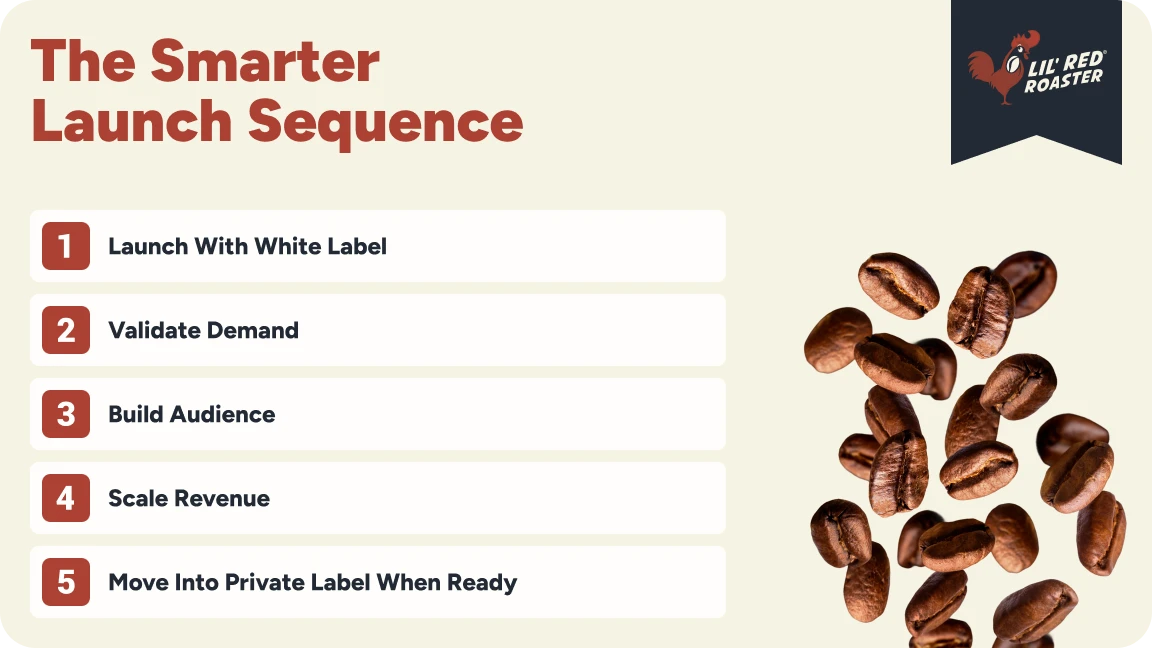
White label is not a lesser strategy. In many cases it is the smarter starting strategy because it lets the business validate demand before building operational complexity.
Ready to launch your own coffee brand quickly and with lower risk? Contact Lil Red Roaster to explore our White Label program.
Time to Market Comparison
Mature brands with proven volume needing custom formulations and proprietary blends.
Speed matters because revenue validation matters. A slower model may be appropriate for a mature brand. It may be unnecessary risk for a new concept.
Capital Exposure Comparison
Private label can create exposure through minimum order quantities, packaging inventory, development costs, and unsold product. White label reduces exposure because the business can start with a more proven production model and scale based on real demand.
The wrong decision is expensive because coffee is perishable from a quality standpoint. Inventory that does not move quickly loses freshness, margin, and customer satisfaction.
Behavioral Reality: Why Businesses Choose the Wrong Model
Companies often choose private label early because it feels more legitimate. It signals ownership. It feels more differentiated. The problem is that early stage businesses usually do not fail because they lacked theoretical differentiation. They fail because they could not get to market, learn fast enough, or preserve capital while demand was still uncertain.
White label can be a strategic advantage because it lets the company focus on demand creation rather than production design.
Decision Framework
- Is customer demand already proven.
- Do you have reliable volume forecasts.
- Can you absorb inventory risk.
- Is custom formulation necessary now.
- Do you need speed more than control.
- Does the brand have channels ready to sell immediately.
Consequences of Getting It Wrong
Choosing private label too early can create inventory pressure, delayed launch, margin strain, and operational distraction. Choosing white label when a mature brand needs true differentiation can limit control. The correct model depends on stage, not ego.
Final Position
Private label offers control. White label offers speed and capital efficiency. Early stage brands should not confuse control with strategy. The fastest path to validated revenue is often the smarter path.
If the goal is to launch, test, and scale with lower risk, evaluate white label first. If the goal is to own a custom product after demand is proven, then private label becomes the next strategic step.
Frequently Asked Questions
Q: What is the difference between private label and white label coffee?
A: Private label usually involves more customization and more operational complexity, while white label uses existing production systems under your brand for faster launch.
Q: Which model is better for an early stage brand?
A: White label is often the safer first step because it reduces capital exposure and speeds validation.
Q: When does private label make sense?
A: Private label makes more sense when demand is already proven, volume is predictable, and the brand can support custom development and inventory risk.
Q: Why does speed matter so much?
A: Speed matters because real customer demand is more valuable than theoretical differentiation built before the market has validated the concept.
What This Unlocks Next
The next issue in the buying journey is rarely isolated. Once this question is answered, the next pressure point usually becomes visible in the next layer of the system.
Read the next article in the Lil Red Roaster series: Are Coffee Subscriptions Worth It? The Real Economics of Freshness, Cost, and Consistency
Subscribe to get the next Lil Red Roaster insight on workplace coffee, espresso quality, private label and white label coffee, subscriptions, roast selection, and beverage program ROI.