Coffee Consistency Across Multiple Locations: A Quality System for Hospitality and Retail Teams
Multi-location coffee consistency requires a defined product, water target, equipment standard, gram based recipe, training process, maintenance plan, and quality audit. Standardizing the bag alone is not enough because water, grinders, equipment, and staff behavior change the cup.


The Same Bag Does Not Guarantee the Same Cup
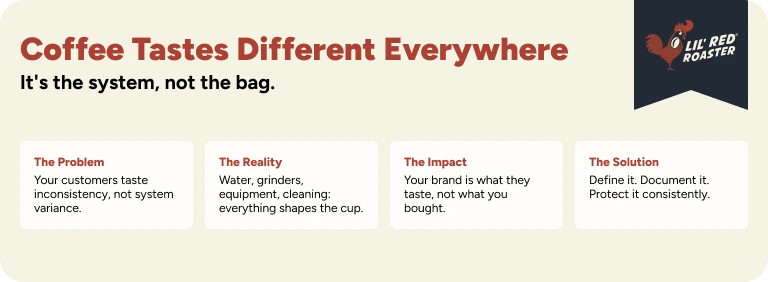
Multi-location operators often assume that product standardization creates beverage consistency. It is an important start, but the cup is produced by a system. Water, grinders, brewers, espresso machines, filters, recipes, cleaning, storage, staff habits, and service timing all influence the result. The same coffee can perform very differently when those conditions drift.
This matters because customers experience the brand through the cup, not through the purchasing contract. A guest who enjoys coffee at one location and receives a weak or bitter version at another does not see an equipment variance. The guest sees an inconsistent brand.
Define the Product Standard
Consistency begins with a clear product decision. The organization should know which coffee is used for each method, what the intended flavor direction is, and what substitutions are acceptable. A core coffee may need broad appeal and operational flexibility. A featured coffee may carry more origin character and require tighter training.
The roaster should document roast and product changes that affect the account. When a new crop arrives, the buyer and service team should know whether the flavor, density, or recipe recommendation changed. Silent substitutions create avoidable confusion.
Set a Water Target, Not One Filter Model
Water differs by market. Multi-location brands need a target for taste, hardness, alkalinity, and equipment protection, then a local treatment plan that moves each location toward that target. Installing the same filter everywhere may create different results because the incoming water is different.
Water should be tested during installation, after major municipal changes, and when flavor or scale problems appear. Filter replacement must be scheduled by actual capacity and use. A cartridge that remains installed beyond its effective life is not a quality system.
Standardize Equipment and Recipes Where It Matters
Equipment variety increases training and maintenance complexity. When possible, operators should limit brewer, grinder, and espresso machine variation. When different equipment is unavoidable, each configuration needs its own documented recipe and quality expectation.
Recipes should use grams, liters, beverage weight, and time rather than scoops and visual guesses. The team should know the dry dose, water or beverage output, grind reference, brew time, and holding limit. Those controls make troubleshooting possible across locations.
Create Training That Survives Turnover
A program is only consistent if a new employee can learn it quickly. Training should explain what to do, why it matters, and how to recognize failure. A simple recipe card, cleaning checklist, grinder adjustment guide, and tasting reference can be more useful than a long manual no one opens.
Managers need a separate layer. They should know how to check execution, coach the team, identify equipment issues, and escalate problems to the roaster or service provider. Quality cannot depend on one enthusiastic employee who eventually leaves.
Cleaning Is a Flavor Standard
Coffee oils, fine particles, milk residue, and mineral scale accumulate. Dirty equipment adds rancid, bitter, or stale character that can overwhelm the coffee. Cleaning therefore belongs in the recipe, not in a separate facilities conversation. The program should define daily, weekly, and periodic tasks by equipment type.
Compliance should be visible. Checklists, manager signoff, automated reminders, and service records help the company distinguish training problems from mechanical problems. A clean machine also makes sensory feedback more reliable.
Use Simple Quality Audits
Location Quality Audit
- Confirm product and roast date
- Check water and filter status
- Verify dose, output, grind, and brew time
- Taste coffee at service temperature
- Inspect cleaning and storage
- Review equipment errors and service records
- Record corrective action and owner
Audit frequency should match risk and volume. High volume locations may need daily checks and regular regional reviews. Lower volume sites still need enough oversight to prevent slow drift. The goal is not punishment. It is rapid correction before inconsistency becomes normal.
Build a Feedback Loop With the Roaster
A commercial roaster should be more than a shipment source. The relationship should make it easy to report flavor changes, train new teams, adjust recipes, review new equipment, and prepare for crop transitions. Lil Red can use account feedback to identify whether a problem is isolated or appearing across the network.
That feedback loop protects both sides. The operator gains faster resolution and stronger consistency. The roaster gains visibility into how the coffee performs outside the roastery. Together they can manage the full beverage system rather than arguing over the bag after the cup fails.
Clear Ownership Keeps the Standard From Fading
Multi-location programs often launch with strong training and then lose discipline as managers change, new sites open, and equipment ages. Clear ownership prevents the standard from depending on memory. One person should be accountable for the beverage program, while location managers handle daily checks and the roaster or service partner provides clearly defined support.
Changes should be documented. If a location substitutes a filter, grinder setting, product, or holding procedure, the reason should be recorded. This allows the organization to trace changes and learn from them instead of allowing invisible variation to spread.
Performance data can remain simple. Product usage, waste, service incidents, filter changes, training completion, and periodic taste scores are often enough to reveal where attention is needed. The objective is not a large dashboard. It is early visibility into drift.
The strongest programs also create a launch checklist for every new location. Water is tested, equipment is commissioned, recipes are verified, staff are trained, the opening product is available, and escalation contacts are known before the first customer is served. Expansion becomes easier because the quality system travels with the brand.
Consistency Creates Better Commercial Data
When recipes and operating conditions are stable, customer feedback becomes more useful. A sales decline can be investigated without wondering whether every location changed the brew differently. Product usage can be compared more fairly. Training investments can be evaluated against quality results. Consistency therefore improves not only the cup, but also the quality of management information.
This is particularly valuable during growth. New locations create complexity faster than most teams expect. A documented coffee system gives leadership a repeatable opening model and makes it easier to identify whether a problem belongs to product, equipment, process, or local execution.
A Quality System Supports Growth Without Losing the Brand
As the network expands, the coffee program should become easier to teach, audit, and improve. That does not require removing every local choice. It requires defining which elements protect the brand and which can adapt. Product promise, water quality, recipe, cleaning, and service standards belong in the protected core.
Consistency Creates a Scalable Coffee Program
The commercial payoff is a more reliable guest experience, fewer emergency corrections, clearer purchasing data, and a program that can expand without forcing every new location to rediscover the same lessons. Consistency is not rigidity. It is a shared baseline that helps teams move faster because the important variables are known and measurable.
Frequently Asked Questions
Why does the same coffee taste different across locations?
Water, grinder calibration, equipment temperature, dose, brew volume, cleaning, freshness, and staff execution can all vary even when the coffee is the same.
What should be standardized first?
Start with the product, water target, equipment, measured recipe, cleaning schedule, and training language. Those create the operating baseline.
How often should quality be audited?
Daily operational checks should be simple and frequent. Deeper sensory and equipment audits may occur monthly, quarterly, or when performance changes.
Can one coffee work across every location?
It can when the customer profile and equipment are similar, but some groups benefit from a core coffee plus location specific or seasonal options. The decision should be deliberate.
Sources & Further Reading
Specialty Coffee Association — Coffee Standards
Specialty Coffee Association — Water and Coffee Acidity
Create a More Consistent Coffee Program
Bring your locations, recipes, water, training, and equipment into one clear standard that is easier to teach and maintain.