Is Coffee Getting Too Complicated? A Case for Seriously Good Coffee Without the Snobbery
Specialty coffee is reaching record popularity, but enjoying a great cup shouldn't require a glossary. Here is why quality coffee should be approachable and easy to enjoy.


Coffee has gotten better. But somewhere along the way, ordering it got a little harder.
Single origin. Washed process. Natural process. Anaerobic fermentation. Extraction percentage. TDS. Bloom time. Agtron score.
We love this stuff. We really do.
But here's the thing:
You shouldn't need to understand any of it to enjoy a seriously good cup of coffee.
That's something we've been reminded of recently while meeting coffee drinkers at local events. Again and again, people have responded to something pretty simple: quality coffee that's approachable and easy to understand.
And we think they're onto something.
Coffee can be fascinatingly complex.
Drinking it shouldn't have to be.
Specialty Coffee Is Becoming Everybody's Coffee
There's something interesting happening in coffee right now.
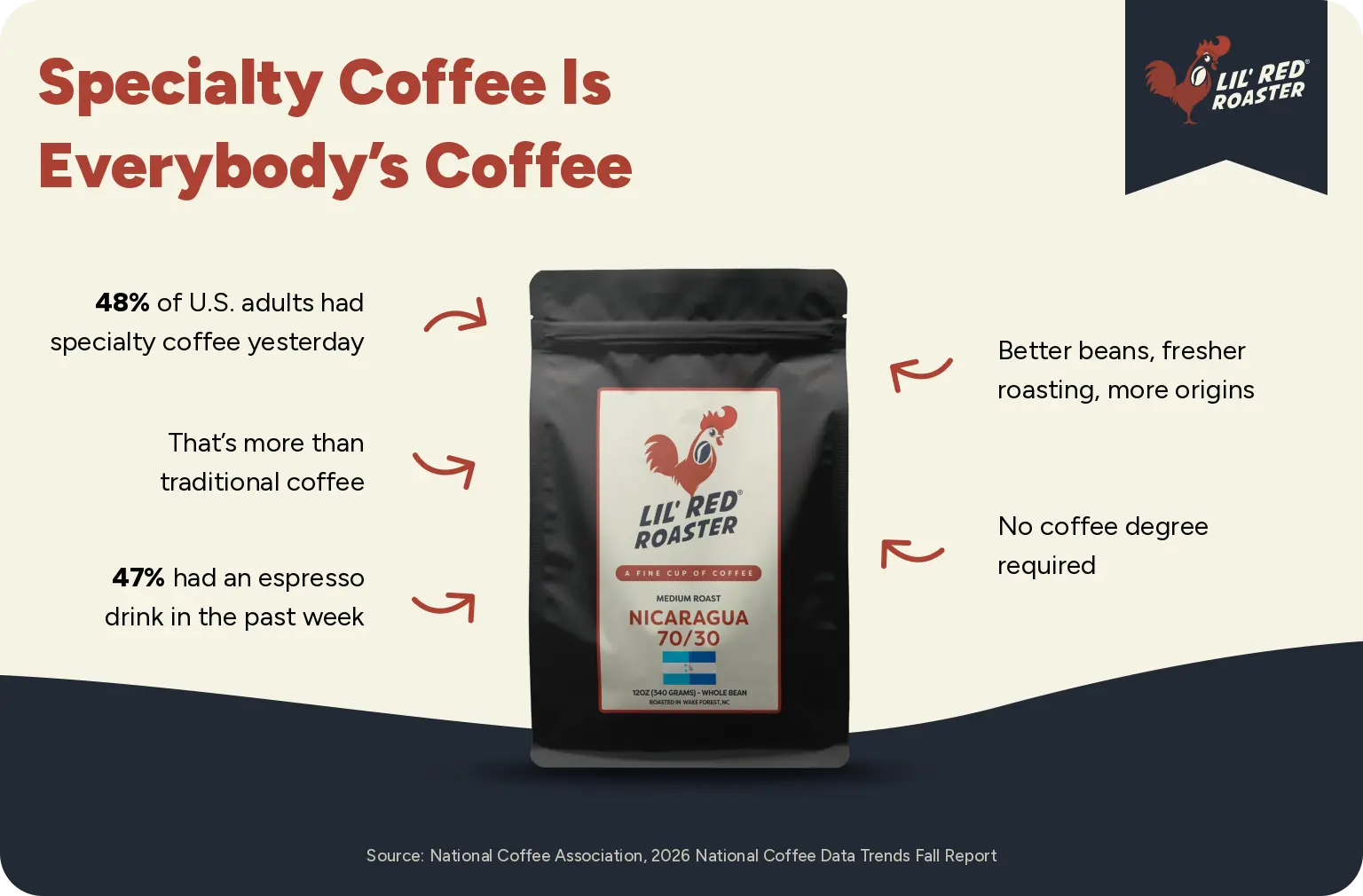
According to the National Coffee Association (NCA) - the oldest and largest U.S. trade organization representing coffee businesses across the industry - specialty coffee consumption has reached a record high. (National Coffee Association)
The NCA's September 2026 National Coffee Data Trends report found that 48% of American adults had specialty coffee in the previous day.
That's more than the number drinking traditional coffee.
And espresso-based beverages are growing, too: a record 47% of American adults reported having one within the previous week. (National Coffee Association)
In other words:
Specialty coffee isn't so “specialized” anymore.
And we think that's great.
More people are discovering better beans, fresher roasting, different origins and better ways to brew.
But there's another side to that growth.
The more sophisticated coffee becomes, the easier it is to make people feel like they don't know enough about it.
That's where we think coffee could use a little reality check.
When Did Drinking Coffee Require a Dictionary?
Walk into the right coffee shop today and you might encounter a description that sounds something like:
Single-origin, high-elevation, anaerobic natural-process coffee with notes of hibiscus, fermented strawberry and cacao nib.
Sounds interesting.
But what if your first thought is:
"Okay...but will I like it?"
That's a perfectly reasonable question.
Coffee professionals use terminology for good reasons. Origin, processing, roast development and brewing technique really do affect what ends up in your cup.
The problem isn't the knowledge.
The problem is when knowledge becomes a barrier.
If you need five minutes of explanation before you feel confident buying a bag of coffee, the industry may have made your decision harder instead of easier.
We'd rather tell you what matters.
Good Coffee Doesn't Need a Secret Handshake
Here's our position:
You don't need to know everything about coffee to know what you like.
Maybe you want something dark, rich and chocolatey.
Maybe you like bright and fruity.
Maybe you want a smooth cup that tastes good with cream.
Maybe you're standing in your kitchen at 6:17 in the morning and simply need something reliably delicious to happen.
All legitimate answers.
Coffee expertise should help you find that cup—not make you feel like you're taking a test.
That's a distinction we care about at Lil' Red.
We take making the coffee seriously.
You shouldn't have to take drinking it seriously.
What Actually Matters When Choosing Coffee?
Forget the vocabulary for a minute.
If you're staring at a shelf of coffee and don't know where to start, we'd focus on four things.
1. What flavors do you normally enjoy?
Chocolate and caramel? Fruit and citrus? Nutty and smooth? Rich and smoky?
Start there.
You don't need to identify "blackberry compote with jasmine aromatics."
"Chocolatey" works just fine.
2. How do you brew it?
Drip machine? French press? Pour-over? Espresso? Cold brew?
Different coffees and roast profiles can behave differently depending on how they're brewed, so knowing your normal method helps narrow the field.
3. How roasted do you like your coffee?
Light, medium and dark aren't rankings from weakest to strongest.
They're different expressions of the coffee.
Lighter roasting can preserve more origin character and brightness. Darker roasting generally creates deeper roasted flavors and fuller-bodied impressions. Medium sits somewhere between those poles, with enormous variation depending on the coffee and roaster.
4. Is it fresh?
Coffee is an agricultural product that changes after roasting.
Freshness matters.
Those four questions will get most people much closer to a coffee they'll actually enjoy than memorizing a glossary ever will.
Want some help? [Find your Lil' Red roast →]
Quality Still Matters. A Lot.
Making coffee approachable doesn't mean lowering the bar.
Actually, we'd argue the opposite.
The expertise behind your coffee should be doing the hard work for you.
Sourcing matters.
Roasting matters.
Freshness matters.
Consistency matters.
Understanding how a particular coffee responds to heat matters.
Knowing how different origins, processing methods and roast profiles influence flavor matters.
Lil' Red has decades of roasting experience behind what goes into the bag.
But here's the important part:
Expertise should create confidence, not homework.
A chef doesn't expect you to understand the chemistry behind a great sauce before you're allowed to enjoy dinner.
Coffee shouldn't be any different.
What's "Specialty Coffee," Anyway?
Here's where things get slightly confusing.
Within the professional coffee industry, "specialty coffee" has historically been associated with specific quality standards and evaluation systems.
But consumers don't necessarily use the term the same way.
Even the National Coffee Association points this out in explaining its consumer research. Its National Coffee Data Trends study uses a broader consumer-oriented definition that includes premium whole-bean or ground coffee as well as beverages such as espresso drinks, cold brew and nitro. The NCA specifically notes that consumers may interpret "specialty" simply as meaning high-quality coffee. (National Coffee Association)
That's important.
Because while the industry debates definitions, consumers are usually asking something much simpler:
Does it taste good?
Do I understand what I'm buying?
Is it worth what I'm paying?
Would I buy it again?
Those are questions worth answering.
Coffee Knowledge Should Be an Invitation
None of this means we want people to know less about coffee.
Quite the opposite.
Coffee is fascinating.
The journey from a coffee cherry growing thousands of miles away to what happens inside a roaster to what eventually lands in your morning mug is worth learning about.
We just don't think you should have to learn it all at once.
Want to understand why some coffees taste fruity?
We'll explain it.
Curious why grind size changes your cup?
We've got you.
Wondering whether light roast actually has more caffeine?
That's worth talking about too.
Lil' Red already has resources explaining coffee flavor notes, roast levels, grind size, caffeine and what specialty coffee actually means, so there are plenty of rabbit holes available when you're ready. (Lil' Red Roaster)
The point is that education should feel like:
"Huh, that's interesting."
Not:
"Apparently I've been drinking coffee wrong for 20 years."
You haven't.
What We've Been Hearing From Coffee Drinkers
Some of the best reminders don't come from industry reports.
They come from talking to people.
At recent local events, the Lil' Red team has had the chance to put coffee directly into people's hands, answer questions and hear what they actually care about.
One theme keeps showing up:
People want quality - but they also want approachable and easy to understand.
That matters to us.
Because those aren't competing ideas.
You don't have to choose between serious quality and having a good time.
You don't have to choose between knowing your coffee and welcoming someone who's just figuring out what they like.
And you definitely don't have to make someone feel stupid because they can't explain the difference between washed and natural processing.
Ask us.
We'll tell you.
Prefer to just drink the coffee?
We'll pour you another cup.
Seriously Good Coffee. That's Pretty Much It.
The coffee world is going to keep evolving.
There will be new brewing methods.
New processing techniques.
New equipment.
New terminology.
New trends we're all supposed to know about.
We'll keep paying attention to them.
We'll keep learning.
We'll keep obsessing over the details that make coffee better.
But when you pick up a bag of Lil' Red, we'd rather make the decision pretty straightforward:
Here's what it tastes like.
Here's how it's roasted.
Here's how we'd drink it.
Here's why we think you'll like it.
No secret handshake required.
Because great coffee should bring people together—not make anyone feel like they don't belong at the table.
And if that makes coffee a little less complicated?
Good.
We'll drink to that.
Frequently Asked Questions
What does "specialty coffee" actually mean?
The term has specific meanings within the professional coffee industry related to quality and evaluation, while consumers often use "specialty coffee" more broadly to mean premium or high-quality coffee. The National Coffee Association's consumer research intentionally reflects that broader understanding when measuring specialty consumption. (National Coffee Association)
Do I need to understand coffee tasting notes to choose good coffee?
No. Tasting notes are simply descriptions that help communicate flavors and aromas people may experience in a coffee. Start with broad characteristics you already know you enjoy—chocolatey, nutty, fruity, bright, rich or smooth—and explore from there.
Is light, medium or dark roast best?
There isn't a universally "best" roast level. Roast level changes how a coffee presents itself, so the right choice depends on the flavors and brewing experience you enjoy.
What should a beginner look for when buying coffee?
Start with flavor preference, roast level, brewing method and freshness. Those factors can help you make a confident choice without needing extensive coffee knowledge.
How can I learn more about coffee without getting overwhelmed?
Learn one thing at a time based on what you're actually curious about. If your coffee tastes sour, learn about extraction. If you're buying a grinder, learn about grind size. If a tasting note catches your attention, explore where those flavors come from. Coffee education is a lot more useful