How to Choose the Right Coffee Roast: Flavor, Strength, and What Most People Get Wrong
Learn how roast level changes flavor, acidity, body, and brew behavior so you can choose coffee intentionally instead of using roast as a strength myth.


Roast Level Is Not Strength
Roast level is one of the most misunderstood variables in coffee. Many consumers believe dark roast is stronger, light roast is weaker, and medium roast is a compromise. That assumption is wrong.
Roast level changes flavor, body, acidity, solubility, and how the coffee behaves during brewing. Strength is primarily controlled by coffee to water ratio and extraction, not by roast label.
What Roasting Actually Does
Roasting transforms green coffee through heat. The process creates browning reactions, caramelization, moisture loss, structural expansion, and aromatic development. As the roast gets darker, acidity decreases, body usually increases, origin character becomes less pronounced, and roast driven flavors become more dominant.
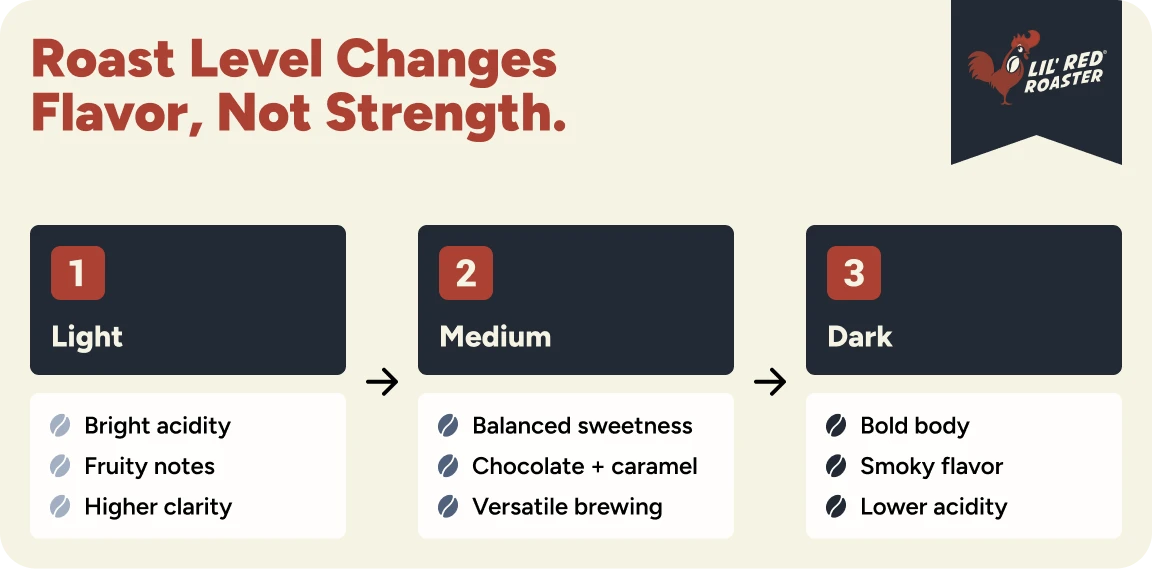
Roast Spectrum Visual Guide
- Light Roast: High acidity, origin clarity, floral/fruity notes.
- Medium Roast: Balanced acidity and body, caramel, chocolate, nutty notes.
- Dark Roast: Low acidity, heavy body, smoky, intense roast flavor.
Light Roast
Light roast preserves more origin expression. It can taste bright, floral, citrusy, fruity, and complex. The tradeoff is that light roasts can be harder to extract and may taste sharp or sour if brewed poorly.
Light roast is best for drinkers who want clarity, complexity, and origin character, especially with pour over or carefully controlled brewing.
Explore our Light Roast Collection
Medium Roast
Medium roast is often the most balanced choice. It preserves some origin character while developing sweetness, chocolate, caramel, or nutty notes. It performs well across drip, espresso, French press, and everyday brewing.
Medium roast is best for drinkers who want consistency, balance, and versatility.
Explore our Medium Roast Collection
Dark Roast
Dark roast emphasizes body, bitterness, smoke, and roast developed flavor. It can be easier to extract and more forgiving for some brewing methods, but it usually reduces nuance and origin clarity.
Dark roast is best for drinkers who want a heavier, bolder cup with lower acidity.
Explore our Dark Roast Collection
Stop guessing and start brewing.
The Caffeine Myth
The belief that dark roast contains much more caffeine is misleading. Roast level can slightly affect caffeine concentration depending on whether coffee is measured by scoop or weight, but brew ratio and dose matter more in the cup. A stronger tasting coffee is not automatically higher caffeine.
Brewing Method Interaction
Roast selection should match brew method. Espresso often performs well with medium to medium dark profiles because they balance solubility and sweetness. Pour over often rewards light to medium roasts because those methods highlight clarity. French press can support medium to darker profiles because immersion brewing emphasizes body.
Decision Framework
- Choose light roast if you want acidity, complexity, and origin expression.
- Choose medium roast if you want balance, sweetness, and flexibility.
- Choose dark roast if you want body, lower acidity, and bold roast flavor.
- Do not use roast level as a proxy for caffeine.
- Match roast to brew method and skill level.
Consequences of Getting It Wrong
A light roast brewed carelessly may taste sour. A dark roast chosen for strength may taste bitter. A medium roast may be the right answer for a customer who wants consistency but thinks they need something stronger.
Final Position
Roast level is flavor engineering. It is not a strength scale. Understanding that distinction helps customers choose coffee intentionally instead of guessing.
If your coffee does not taste the way you expect, start with roast selection before changing equipment.
Frequently Asked Questions
Q: Is dark roast stronger than light roast?
A: Not necessarily. Dark roast usually tastes bolder, but strength in the cup depends more on dose and extraction than roast label alone.
Q: Which roast is best for espresso?
A: Many espresso drinkers do well with medium to medium dark profiles because they balance sweetness, solubility, and body.
Q: Does roast level change caffeine?
A: The difference is often overstated. Brew ratio and dose generally matter more in the cup than roast color alone.
Q: How should I choose a roast?
A: Choose based on desired flavor, acidity, body, brew method, and how much complexity or consistency you want.
What This Unlocks Next
The next issue in the buying journey is rarely isolated. Once this question is answered, the next pressure point usually becomes visible in the next layer of the system.
Read the next article in the Lil Red Roaster series: The Real Cost of Bad Coffee in the Workplace: Why It Quietly Impacts Productivity, Retention, and Culture
Subscribe to get the next Lil Red Roaster insight on workplace coffee, espresso quality, private label and white label coffee, subscriptions, roast selection, and beverage program ROI.